Until 30 September

Key takeaways
For those looking for a quick overview of how footballer taxation works, here are the main points covered in this article:
Standard employee taxation: Most Premier League footballers are paid via PAYE, meaning they are subject to standard UK Income Tax and National Insurance rates just like other employees.
Loss of Personal Allowance: Due to the tapering of the Personal Allowance for high earners, top-flight players effectively have £0 tax-free allowance and pay the additional rate of 45% on the majority of their earnings.
Significant tax contributions: Top stars contribute millions to the public purse annually; for example, Erling Haaland’s estimated annual tax bill exceeds £12 million.
Agent fees scrutiny: HMRC is closely monitoring ‘dual representation’ deals to ensure agent fees paid by clubs are not used as a tax avoidance strategy.
Image rights complexity: Payments for image rights must reflect genuine commercial value. Otherwise, they may be treated as disguised remuneration by tax authorities.
If there's one thing we all know here in the UK, it’s that football is definitely coming home!
Indeed, to say our great nation is a little football-mad would be an understatement. Maybe it’s because we invented the sport back in 1170. But if there’s one thing that’s certain, it’s that football truly is England’s national sport.
And that got us thinking here at Payfit, about footballer earnings, naturally, and their net income. After all, when you’ve got your head in tax and NIC calculations all day, you tend to start thinking about these things.
Many of us have heard about the exorbitant wages of Premier League stars. However, very few of us understand just how their remuneration is broken down, or how much they actually pocket for bringing it home.
So let’s take a peek at what Premier League players actually make, and how much of this effectively goes to the taxman.
Quick disclaimer
Before we get started, it’s important to note that the figures we’ll reference in this piece are based on information widely available online. In reality, these may vary.
In addition to that, the purpose of this article isn’t to shame any of the parties mentioned! We’re simply a very curious bunch here at Payfit and like digging into how these things might work, hypothetically from a tax and NIC point of view.
Lastly, we’ve based our calculations on the assumption that any party mentioned is paid as an employee through PAYE. So these will always be just an estimate.
How are UK employees generally taxed?
To understand how much tax a footballer pays, it’s first helpful to look at how ordinary UK-based employees are levied.
The amount of tax someone contributes will vary depending on how much they earn. This figure is also affected by the tax code assigned to that individual.
Tax codes indicate how much of a person’s earnings will be free of tax. The most common tax code in the UK is 1257L. Someone with this code would receive £12,579 for their Personal Allowance. This means that the first £12,579 they earn would be completely tax-free, and, consequently, they would only face deductions on any money above this amount.
An employee earning an average UK wage of £31,461, and with the 1257L code, would have their remuneration broken down as shown below.
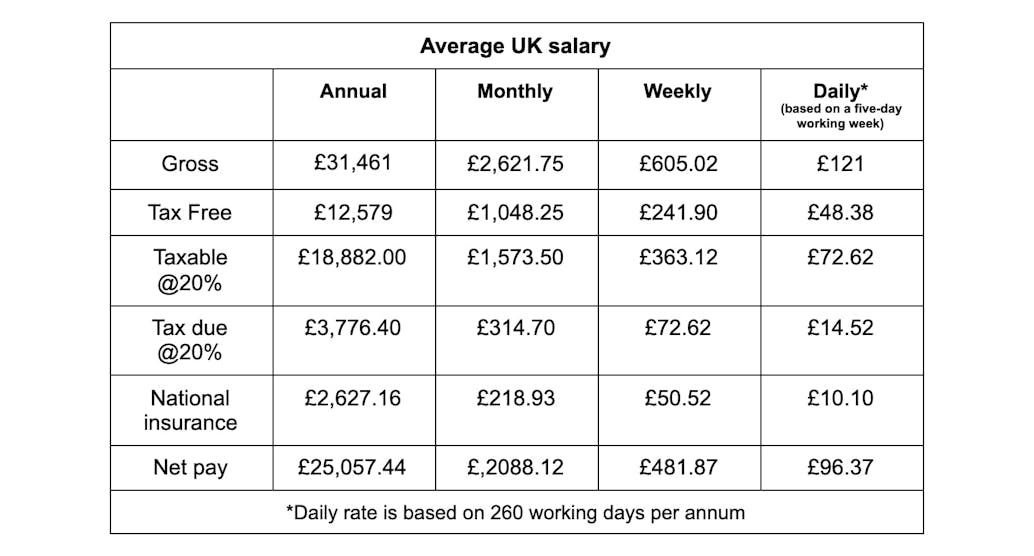
From the original £31,461 annual figure, £12,579 would be completely tax-free. This means that an employee would only face charges on the remaining £18,882.00.
They would be taxed 20% of this, equalling £3,776.40. The NICs would be an additional £2,627.16, meaning that the employee would pocket £25,057.44 in net earnings during the year.
The 20% band is also referred to as the basic rate, and employees earning up to £50,270 a year fall into this category. Money earned above this amount is levied at 40% (higher bracket). There is a third threshold, also referred to as the additional bracket. Any earnings above £150,000 are levied at 45%.
Curious how UK businesses manage these complex calculations? Modern payroll software automates tax deductions, ensuring accuracy and HMRC compliance.
What are Premier League wages like?
According to the Global Sports Salary Survey, the average pre-pandemic wage for a footballer playing in England’s Premier League was a staggering £60,000 a week.
Did you know?
The average wage of a Premier League footballer pre-pandemic was £60,000 a week. This works out at over £3 million a year pre-tax.
Breaking down an average Premier League player’s salary
The table below breaks down how much a footballer might pay in tax and NICs. We’ve also split the earnings into the different tax brackets to show how much of the salary is taxed at the varying rates.
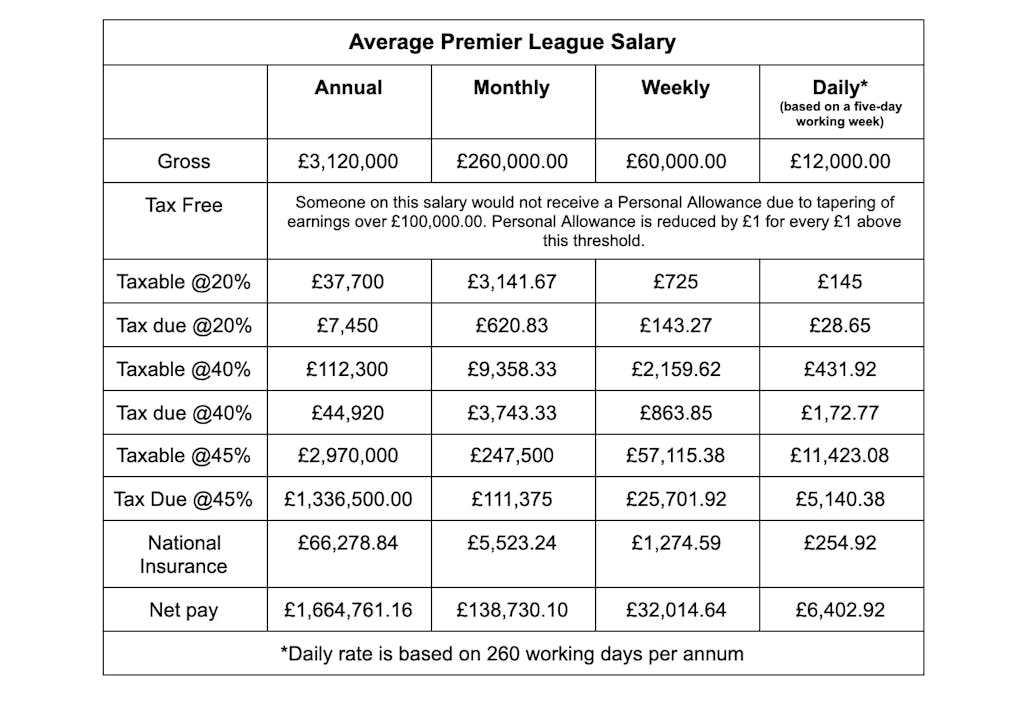
A £60,000 weekly wage equates to just over £3.1m annually. Anyone earning that amount of money would not be entitled to a Personal Allowance.
From the £3.12m annual income, £37,700 would be taxed at 20%, and £112,300 would be taxed at 40%. The remaining £2.97m would be taxed at 45%.
Altogether, someone earning this amount would contribute £1,388,870 in tax and an additional £66,278.84 in NICs. This would leave them with a net income of £1,664,761.16.
Who are some of the heavy hitters in the Premier League?
While a £60,000 weekly wage may be the average in the Premier League, some players, particularly the best, can be on an awful lot more.
Let’s take, for example, the Premier League’s highest earner in 2021, Manchester City playmaker Kevin de Bruyne. He raked in a staggering £385,000 a week, and over £20m a year pre-tax.
The highest-earning Englishman, Raheem Sterling, earned roughly around £300,000 per week, and, pre-tax, £15.6m per year.
England’s talisman and captain Harry Kane took in about £200,000 a week. This gave him an annual income of £10.4m pre-tax.
To help understand Kane’s earnings, we produced a table detailing how much he would receive annually, monthly, weekly, and daily.
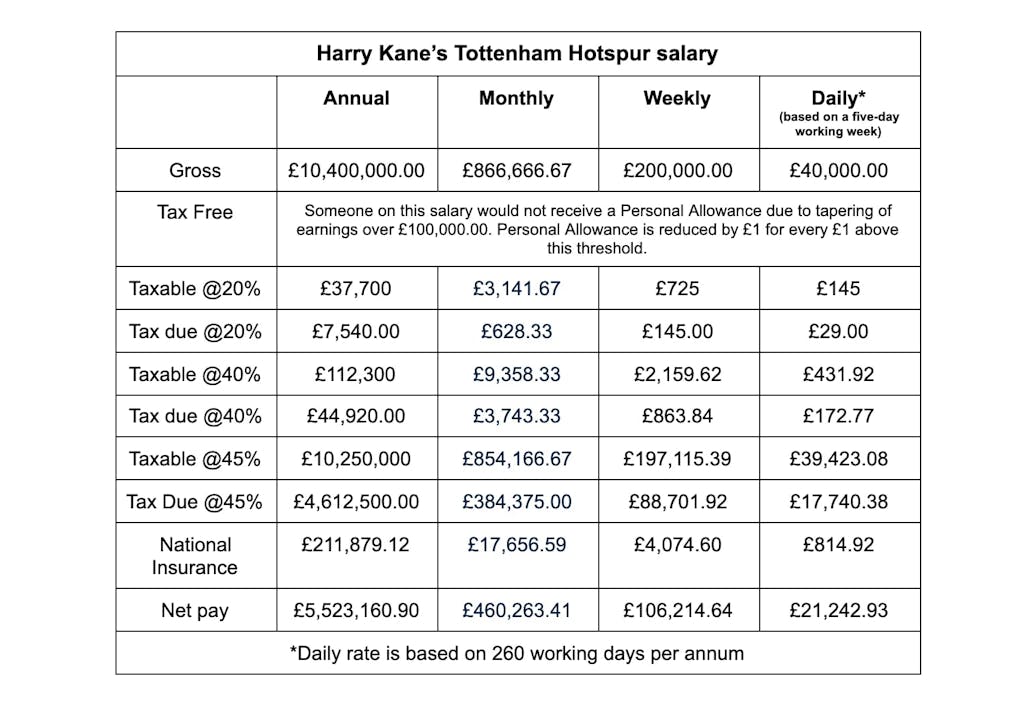
From Kane’s original £200,000 weekly earnings, he would pocket £106,214.64. The remaining £93,785.36, including £4,074.60 NIC, is taken by the taxman.
Over the course of the year, Kane’s £10.4m annual wages would leave him with a take-home amount of slightly over £5.5m. The total deductions would be just under £4.9m.
A guide for businesses

What are Premier League wages like in the 2025/26 season?
With the 2025/26 tax year in full swing and player wages hitting new heights, the gap between the stands and the pitch has never been wider financially speaking. Let’s crunch the numbers on what the Premier League’s elite actually pocket after the taxman blows the final whistle.
The 2024/25 season and the subsequent transfer windows have, in fact, cemented the Premier League’s status as the financial powerhouse of global football.
Leading the pack is Manchester City's goal-machine Erling Haaland. Following his contract extension in January 2025, Haaland is reported to be earning a staggering £525,000 per week. This deal pushes him comfortably ahead of teammates like Kevin De Bruyne and league rivals such as Mohamed Salah.
To put that into perspective, the average annual wage for a full-time employee in the UK as of April 2025 is approximately £39,000. That means Haaland earns the average annual UK wage in just over 12 hours.
What are the rules of the game in 2025/26 in terms of tax bands?
Before we get to the final score (net income), we have to look at the rules of the game, specifically, the UK tax bands for 2025/26.
Personal allowance: £12,570 (frozen).
Basic bracket (20%): On income between £12,571 and £50,270.
Higher bracket (40%): On income between £50,271 and £125,140.
Additional bracket (45%): On income over £125,140.
National Insurance (NI): Employees now contribute 8% on earnings between the primary threshold and the upper earnings limit, and 2% on everything above that.
For anyone earning over £100,000, the Personal Allowance tapers off to zero. For every £2 earned above £100k, £1 of the allowance is lost. This means players like Haaland have a personal allowance of £0.
How does the payslip of an average UK earner compare to the Premier League’s top earner?
Let’s pitch the payslip of an average UK earner up against the league’s top earner.
Average UK Employee:
Gross annual wages: £39,000
Taxable income: £26,430
Total deductions: £7,400
Annual take-home: £31,600
Erling Haaland:
Gross annual wages: ~£27.3m (£525k/week)
Taxable income: £27.3m (£0 personal allowance)
Income tax (total): ~£12,266,175
National Insurance: ~£548,010
Total deductions: ~£12,814,185
Annual take-home: ~£14,485,815
Even after contributing over £12.8m to the UK treasury in a single year, which is enough to cover the average wages of over 320 nurses, still Haaland walks away with over £14m net.
Beyond the wage, what is the deal with agents, dual representation and HMRC?
While the headline wages grab all the attention, the financial relationship between clubs, players, and their representatives is far more complex. A key area of scrutiny for HMRC in recent years has been the fees paid to agents.
Historically, an agent acts on behalf of the player to negotiate their contract. Naturally, the player should foot the bill for this service. However, it is common football industry practice for the club to pay the fee on the player’s behalf. This is a taxable benefit in kind for the player (reportable on a P11D form), meaning the player must pay tax on the value of that fee.
To manage this cost, many contracts employ a ‘dual representation’ strategy. This is where the agent is contracted to represent both the club and the player simultaneously. Under this arrangement, it is argued that the agent did 50% of the work for the club, and 50% for the player. This allows the club to pay half the fees directly as a business expense. Consequently, they can reclaim VAT and reduce the player’s income tax liability.
However, HMRC is cracking down on this tax avoidance strategy. New guidance published in March 2024 made it clear: if the agent primarily serves the player, splitting the fee 50/50 is not acceptable. The advice from tax experts is now strictly to ensure the split represents the true commercial value of the services provided to the club.
In a hypothetical case, let’s say a new signing, Dan, joins a top-flight team. If his agent charges £1 million, and the club pays it all via a dual representation agreement without proper justification, HMRC may argue the full amount is the player’s liability. The club could also face penalties regarding Corporation Tax deductions they claimed on the fee. As the old adage says, “render unto Caesar what is Caesar’s”, and, in football, the taxman is definitely watching closely!
While the numbers are astronomical, the contribution to the public purse is equally significant. So, next time you see a star player miss a sitter, just remember: they are likely one of the country’s biggest individual taxpayers!
Find the right payroll software