NEW
✨ Health insurance, now in PayFit - learn more
LATEST
💷 All the rates & thresholds you need to know for 25/26...right here
WEBINAR
✨ The Payroll Journey: Start, Scale & Succeed Globally - learn more
✨ Health insurance, now in PayFit - learn more
💷 All the rates & thresholds you need to know for 25/26...right here
✨ The Payroll Journey: Start, Scale & Succeed Globally - learn more


As we progress through 2026 and through to the new tax year 2026/27, UK businesses face a transformed payroll reality following significant reforms to National Insurance contributions and thresholds that continue to reshape financial planning and tax strategies for every growing company.
The main National Insurance changes in 2026 involve adapting to the full-year impact of the 15% employer rate and preparing for the new Lower Earnings Limit in April.
While the headline rate increase occurred in the 2025/26 tax year, the financial reality is arguably being felt most acutely now, as businesses forecast their full annual costs for 2026.
The government aimed these reforms at raising revenue while attempting to shield smaller businesses through targeted allowances.
Fortunately, adapting to these National Insurance changes is seamless for finance and HR managers using modern payroll software, which automatically updates to maintain accuracy and PAYE compliance.
The increased employer rate significantly raises the cost of employment for businesses across the UK.
Since the rate rose to 15%, up from the previous 13.8%, companies have had to absorb a 1.2 percentage point hike on their payroll tax bill. This increase applies to all earnings above the secondary threshold.
For a growing company with an expanding team, these additional costs add up rapidly. It is no longer just a minor adjustment but becomes a strategic consideration for recruitment and salary planning. Using a robust and updated payroll and salary calculator can help you estimate these impacts on your bottom line and your total pay bill.
The reduction of the secondary threshold has impacted liabilities by widening the band of earnings subject to employer contributions.
The threshold was lowered to £5,000 per year, down from the previous £9,100. This means that you now start paying the 15% rate on a much larger portion of an employee’s salary.
Previously, earnings between £5,000 and £9,100 were exempt from employer NICs. Now, they are fully chargeable. This double whammy of a lower threshold and a higher rate makes precise budgeting, such as offered by modern HR and payroll software, more important than ever before.
Payroll audit guide & checklist
Most UK employers with a National Insurance liability now qualify for the expanded Employment Allowance, provided they are not a public body or a business with more than half their work in the public sector.
The allowance was increased to £10,500 to help offset the rising costs described above. This relief effectively eliminates the first £10,500 of Class 1 National Insurance liability for eligible employers, significantly reducing the burden of keeping staff employed.
It therefore serves as a crucial buffer, particularly for small and medium-sized enterprises (SMEs) struggling with the rate hikes.
The removal of the £100,000 eligibility cap for the Employment Allowance helps growing companies by allowing them to claim the allowance regardless of their prior year’s liability.
Previously, if your Class 1 liabilities exceeded £100,000 in the previous tax year, you lost access to the allowance entirely.
This cliff-edge has been abolished. Now, even larger growing businesses can claim the full £10,500 relief.
This change incentivises investment in new staff without the immediate penalty of losing tax relief as you scale.
If you want to see how this applies to your specific set-up, automated tools can track your eligibility in real-time.
To benefit from the employment allowance, you must actively claim it through your payroll software.
It is not applied automatically by HMRC. Most modern payroll systems will allow you to submit an Employer Payment Summary (EPS) to declare your eligibility.
Ensuring this is done early in the tax year allows the £10,500 allowance to offset liabilities immediately, aiding cash flow management and allowing you to start saving immediately.
Specific updates for employees and directors largely concern the Lower Earnings Limit and the continued freeze on other personal thresholds.
While the employer side has seen volatility, the UK government has tried to ensure that the employee side is more stable, though the current fiscal drag policy remains an impact factor, due to frozen thresholds.
Therefore, employees will not see a direct change in their primary contribution rates in 2026, but the income levels at which they qualify for benefits are shifting and will likely see change in 2027.
The Lower Earnings Limit (LEL) increase is set to start on 6th April 2026. This threshold, which determines when employees build entitlement to state benefits like the State Pension, is expected to rise to £6,708 per year.
As the LEL is indexed to the Consumer Prices Index (CPI), the final figure will be confirmed in April 2026 to ensure it rises in line with the cost of living. Using modern automated payroll software ensures these statutory limits are updated in real-time, maintaining compliance without manual intervention.
Yes, changes are coming to voluntary contributions for overseas workers, specifically regarding Class 2 National Insurance.
From April 2026, the government is removing the option for individuals living abroad to pay voluntary Class 2 contributions. Instead, they will generally need to pay voluntary Class 3 NICs if they wish to maintain their UK state pension record.
Class 3 rates are typically higher than Class 2, making this a significant change for expatriate employees or those on international secondment. This is an important detail for HR managers handling global mobility.
The following tables summarise the key rates and figures you need for 2026 and the transition into the 2026/27 tax year.
| Category | 2025/26 rate/limit | 2026/27 rate/limit |
|---|---|---|
| Employer Class 1 Rate | 15% | 15% |
| Secondary Threshold (ST) | £5,000 | £5,000 |
| Employment Allowance | £10,500 | £10,500 |
| Employment Allowance Cap | Removed | Removed |
| Category | 2025/26 limit | 2026/27 limit |
|---|---|---|
| Primary Threshold (PT) | £12,570 | £12,570 (frozen) |
| Lower Earnings Limit (LEL) | £6,500 | £6,708 (subject to CPI) |
| Upper Earnings Limit (UEL) | £50,270 | £50,270 (frozen) |
Staying on top of these figures is critical for accurate PAYE deductions. Using the best UK payroll software will ensure these parameters are updated automatically, significantly reducing the risk of manual error.

Most private sector businesses, and also charities and community amateur sports clubs, are eligible, provided they are not public bodies or authorities. The previous £100,000 liability cap has been removed, meaning almost all growing businesses now qualify, although single-director companies remain excluded. Rather than checking these tax rules manually, modern payroll software will validate your company eligibility automatically.
Investment income is generally exempt from National Insurance, meaning it does not contribute to your qualifying years for the State Pension. This distinction is vital for self-employed individuals who rely on dividends or rent, and consequently have low trading profits. If your profits fall below the Small Profits Threshold, you will not build up a record automatically.
To avoid gaps, you may need to pay voluntary Class 2 NICs. Your Self Assessment tax return will automatically separate out these income types. If your trading profits are low, the calculation will offer you the option to pay these voluntary contributions for the tax year just ended, usually at a much lower rate than Class 3.
Using incorrect thresholds can lead to significant overpayments to HMRC, directly impacting your company cash flow. Correcting this requires a formal, additional Full Payment Submission (FPS) to adjust year-to-date figures, a process far more burdensome than a simple payroll undo and re-run before the Real Time Information (RTI) deadline. To mitigate the risk of National Insurance, tax and PAYE errors, you will want to ensure your software handles statutory updates automatically, removing the need for manual checks.
Yes, the Class 1A National Insurance rate, which employers pay on benefits in kind like company cars and health insurance, is linked to the Employer Class 1 rate. Therefore, the rate for Class 1A is also 15%. This increases the cost of providing a benefits package, and requires careful investment in your rewards strategy. When you start planning your benefits packages for April 2026 and beyond, you must factor in this higher NIC charge on the value of the benefits provided in order to ensure your budget remains in check.
Yes, specific reliefs for veterans and employees working in Freeports and Investment Zones continue to apply. These allow employers to apply a zero rate of secondary NICs up to an upper secondary threshold of £50,270 for veterans or £25,000 for freeport and investment zone employees. However, the rules can be complex regarding the qualifying period and specific statutory requirements. Applying the correct tax and National Insurance category letters is essential to ensure that you can claim these state reliefs properly.
The employer National Insurance rate increase does not directly reduce employee net pay. However, the frozen personal thresholds (due to the government’s fiscal drag policy) mean that even as gross pay rises to combat inflation, a larger proportion of that extra income falls into taxable bands, eroding the real value of those pay rises. This indirectly affects work incentive and perceived income. Providing your employees with comprehensive, easy-to-understand online electronic payslips can help them understand their deductions and true earnings more clearly.

National Insurance varies based on a number of different factors. Learn about different UK National Insurance classes, from class 1 NIC to 4, here.

Learn how to submit a Full Payment Submission (FPS) to HMRC in 2026, including deadlines, payroll data requirements, RTI rules, and how to avoid penalties.

Learn how directors’ National Insurance works in the UK in 2026, including rates, thresholds, calculation methods, and key differences from employees.

Learn what an employer reference number (ERN) is in the UK, what it looks like, where to find it, and when you need one for payroll and PAYE admin.

Understand the difference between cumulative & non-cumulative tax codes. Ensure your UK payroll is accurate & HMRC compliant for 2026 & 2026/27.

Understand the PAYE reference number (ERN), learn where to find it, how to register as an employer with HMRC, and why it matters for payroll compliance.
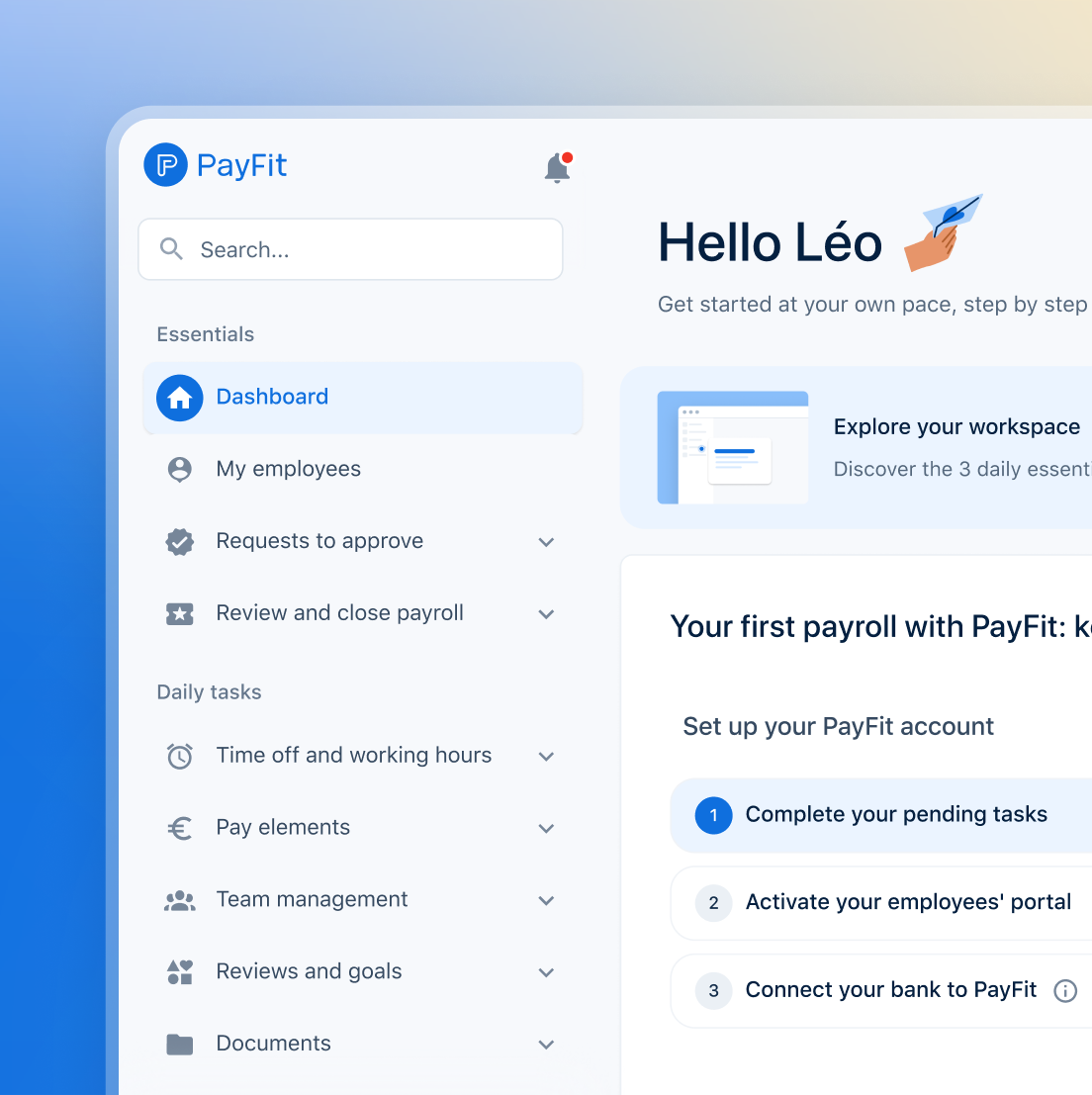
See what's new in PayFit
New features to save you time and give you back control. Watch now to see what's possible