NEW
✨ Health insurance, now in PayFit - learn more
LATEST
💷 All the rates & thresholds you need to know for 25/26...right here
WEBINAR
✨ The Payroll Journey: Start, Scale & Succeed Globally - learn more
✨ Health insurance, now in PayFit - learn more
💷 All the rates & thresholds you need to know for 25/26...right here
✨ The Payroll Journey: Start, Scale & Succeed Globally - learn more


Managing payroll operations in the UK is becoming increasingly complex due to evolving legislation and the need for tighter integration between finance and HR teams to streamline processes. Here are the key things to keep in mind regarding payroll in human resources management:
Effective payroll in human resource management is the backbone of any successful organisation, ensuring financial stability and employee trust through accurate, timely compensation. For any growing business, mastering this legal obligation is essential, and demands dedicated work and systems to help your company thrive and scale.
The role of payroll in human resource management is to bridge the gap between employees' work and their financial compensation.
While often viewed as a finance function, payroll sits firmly within the remit of HR because it deals directly with people, contracts, and sensitive personal data.
Nonetheless, professionals in HR departments and finance teams know that a disconnect between these functions can lead to errors in salary, deductions, net pay, planning, and budgeting.
Therefore, for growing businesses in the UK, alignment between HR and finance is vital, to make sure every payment accurately reflects financial planning and employment terms, from bonuses through to pension contributions.
Finally, by treating payroll as a core part of your people strategy, rather than just an administrative necessity, you can significantly improve the overall employee experience. With efficient payroll systems and processes in place, staff are paid correctly and on time, and the result is a workforce that feels more valued and engaged. HR teams are also freed from repetitive administrative tasks and data entry, and can turn their focus more to culture and growth.
Recent National Insurance changes have increased the financial burden on every business across the United Kingdom. The reforms introduced in the last budget cycle saw the employer National Insurance (NI) rate climb to 15%. This shift has forced finance leaders to budget labour costs far more carefully, in order to ensure the financial sustainability of their businesses.
Crucially, the secondary threshold at which employers start paying NI was reduced to £5,000 per year. This means your company now makes larger contributions on a portion of each employee’s earnings. These NI changes demand precise financial planning to maintain a healthy cash flow. Small and medium-sized enterprises (SMEs) can also leverage the increased Employment Allowance of £10,500 to offset some of these rising costs.
2026 payroll checklist
The regulatory landscape for 2026 will be marked by the implementation of the Employment Rights Act 2025 and new reporting mandates. Keeping up with these laws and legal updates is a key part of HR and finance responsibilities.
The Employment Rights Act 2025 will fundamentally change how statutory pay is calculated and managed from April 2026.
Statutory Sick Pay (SSP) will become a day-one right, removing the traditional three-day waiting period. Furthermore, the lower earnings limit for SSP is set to be removed. This will ensure lower-paid workers receive support during illness, but will increase the administrative volume for your team and the HR processing workload.
Therefore, you will need to ensure your processes can automatically handle immediate calculations without the need for manual interventions.
Finally, the Employment Rights Act 2025 also introduces day-one rights for paternity leave and unpaid shared parental leave, requiring your systems to be agile enough to process such requests instantly.
Mandatory payrolling of benefits in kind is scheduled to start in April 2027, delayed from April 2026. Historically, many companies reported benefits like health insurance or gym memberships annually via P11D forms.
The new rules will require you to process benefits in kind through payroll in real-time. This means tax will be collected every month, rather than at the end of the year.
This shift demands robust software that can handle complex benefit values alongside standard salary processing and deductions. It will simplify tax affairs for employees, but places a higher immediate data burden on the employer to make accurate calculations.
| Regulation | Implementation date | Key impact on employers |
|---|---|---|
| Employer NI Rate (15%) | Active (April 2025) | Higher workforce costs; budget adjustments needed |
| SSP day-one right | April 2026 | No waiting days; removal of earnings limit |
| Payrolling of benefits | April 2027 | Real-time tax reporting for most benefits (P11D retirement) |
| National Living Wage | April 2026 | Projected rise to ~£12.71; narrower gap for 18-20s |
Accurate data is the only defence against costly penalties and investigations from HMRC. In the world of payroll in HR management, a single error in data entry can cascade into incorrect tax codes, pension shortfalls, and compliance failures. Precise data management is thus essential in these critical regulatory areas:
Real-Time Information (RTI): HMRC demands precise reporting on or before every payday. Inaccurate submissions of Real-Time Information will trigger automated penalties.
National Minimum Wage: With the National Minimum Wage rising, failing to track working time correctly can lead to inadvertent underpayments.
GDPR: Handling sensitive personal information demands strict security protocols to prevent data breaches.
Audit trails: You will need a digital footprint of every change made to an employee’s file in order to satisfy legal audits.
Using an automated solution for payroll in HR management minimises human error. It ensures that information flows seamlessly from time-tracking inputs through to final bank transfers, safeguarding the business and its employees from risk and error, and ensuring full compliance with regulations.
Inefficient payroll processes create hidden costs that threaten the stability of a business. When payments are delayed or inaccurate, employees often feel undervalued, leading to higher turnover rates.
Replacing a skilled employee is far more expensive than maintaining a reliable payroll system. Additionally, rectifying incorrect payments consumes valuable time that business leaders should spend on growth.
Ensuring every payment is correct helps the business build a reputation of reliability, keeping employees satisfied and focused.
| Payroll error type | Impact on business | Effect on employees |
|---|---|---|
| Late payments | Loss of trust; operational disruptions | Financial stress for employees |
| Incorrect calculations | Compliance risks; potential fines | Employee dissatisfaction |
| Process delays | Reputational damage to the business | Lower productivity |
Integrated software streamlines processes by removing the friction between HR platforms and payroll engines. When these systems speak to each other, you eliminate the need for duplicate data entry.
For example, when a manager approves a holiday request or a bonus in the HR system, the payroll software should update automatically.
This synchronisation saves time for your resources, reduces the risk of mistakes in deductions and manual tasks, and allows the department to focus on strategy. It transforms payroll from a transactional burden into a strategic asset that helps professionals work smarter and more efficiently.
| Function | Manual process | Automated software |
|---|---|---|
| Data entry | Repetitive, prone to human error | Single entry, syncs across systems |
| Regulatory updates | Requires manual research / tracking | Updates automatically (e.g. tax codes) |
| Employee access | HR prints payslips or emails PDFs | Self-service portals for secure payslips / documents |
| Reporting | Time-consuming Excel compilation | Instant visibility over labour costs |
Growing businesses can prepare for the future by investing in scalable technology that adapts to legal changes.
The projected rise of the National Living Wage to approximately £12.71 in 2026 will compress wage differentials. Therefore, you must analyse your labour costs now in order to maintain profitability and protect the employee experience.
Organisation is key. Review your current setup and ask if it can handle the mandatory payrolling of benefits, or the removal of SSP waiting days.
If your current method involves spreadsheets or disconnected tools, you are exposed to risk. Transitioning to a dedicated, HMRC-compliant payroll solution ensures you will remain ahead of the curve.


2026 payroll checklist
The main changes include an increase in the employer NI rate to 15% and a reduction in the secondary threshold to £5,000. However, the Employment Allowance has increased to £10,500 to help smaller businesses offset these financial costs. It is vital to check how all this impacts your business budget in order to make sure payments remain correct.
Yes, under the Employment Rights Act 2025, SSP will become a day-one right from April 2026. This removes the three-day waiting period, and abolishes the lower earnings limit. You should review your policies to ensure compliance with these new laws and update your employee records, policies and employer handbooks accordingly.
Good software updates automatically when regulations change, ensuring tax codes, student loan deductions, and pension contributions are always accurate. Using HMRC recognised payroll software reduces the risk of fines associated with manual calculation errors in salary processing and deductions.
Integration ensures a single source of truth for employee data. It allows specific tasks like expense management or leave tracking to automatically influence the final pay packet without manual input. This seamless connection saves vast amounts of time and resources for your department.
From April 2027, payrolling most benefits in kind becomes mandatory. You will no longer be able to use P11D forms for these items, so adopting a benefits management system that handles real-time tax collection is essential in order to make reporting easier.
Payroll responsibilities often sit between finance and HR departments. Traditionally, finance has overseen financial liabilities, including tax calculations and deductions from pay, while HR has managed employee inputs, such as contracts and personal information. However, modern organisations increasingly blur these lines, requiring a professional approach and efficient systems that guarantee seamless collaboration between these teams for precise and dependable results.

Compare the best payroll software for UK businesses in 2026. Discover solutions to automate compliance, support growth, & manage employees effectively.

Cloud-based payroll software helps UK businesses improve accuracy, reduce errors and maintain HMRC compliance by centralising payroll data and calculations.

Learn how to run payroll in the UK from how to register for PAYE, calculate tax and NI, send RTI submissions on time, to avoiding HMRC penalties.

We cover the principles of UK payroll accounting, as well as National Insurance rates, 2026/27 tax year compliance & how to streamline your financial reporting.

Understand exactly what is net pay, how to calculate it, and the latest UK tax and National Insurance changes for affecting your payroll.

Learn how to calculate monthly payroll for your UK business. This guide covers gross pay, tax deductions, 2025/2026 rates, and future legislative changes.
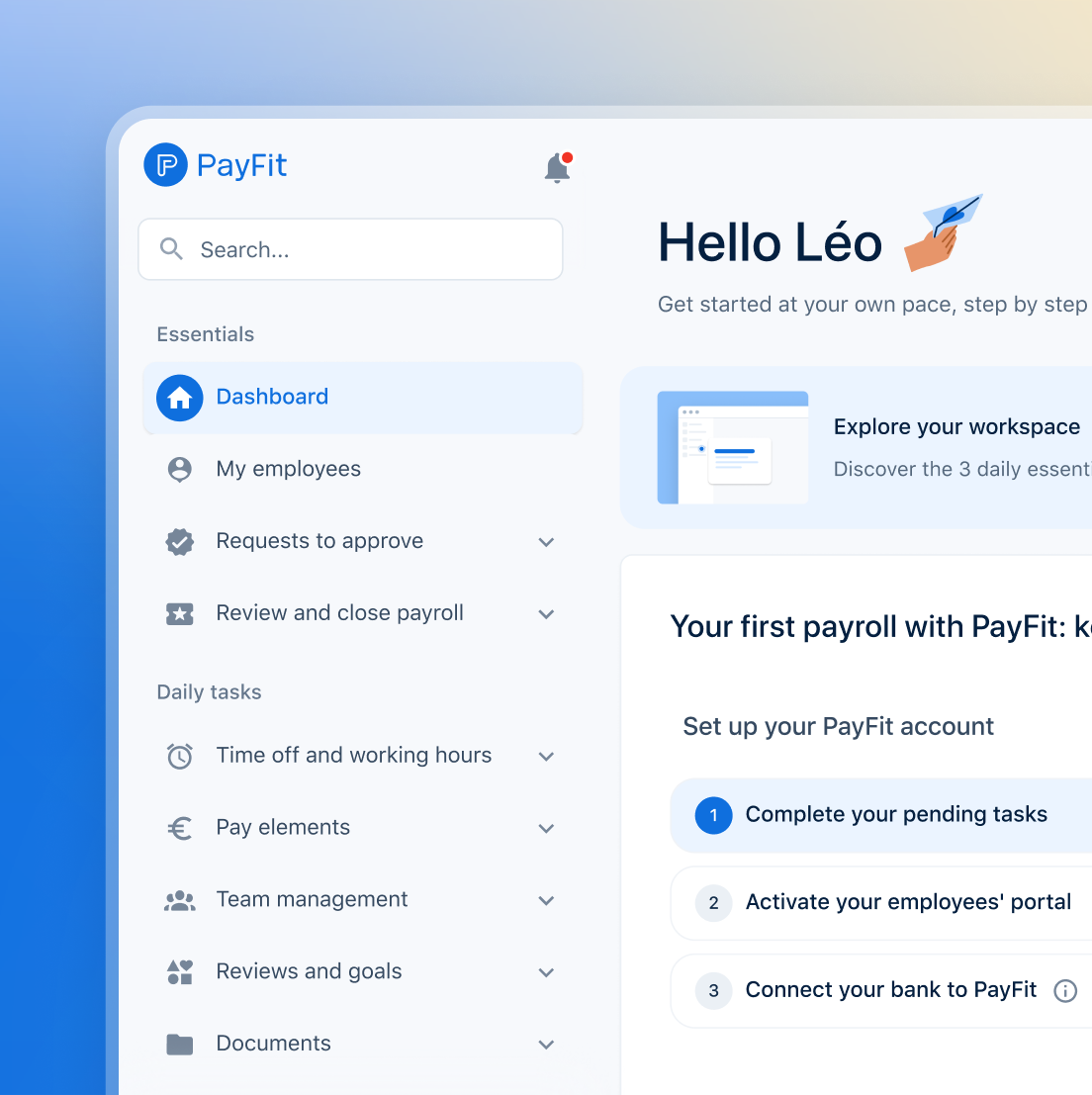
See what's new in PayFit
New features to save you time and give you back control. Watch now to see what's possible