NEW
✨ Health insurance, now in PayFit - learn more
LATEST
💷 All the rates & thresholds you need to know for 25/26...right here
WEBINAR
✨ The Payroll Journey: Start, Scale & Succeed Globally - learn more
✨ Health insurance, now in PayFit - learn more
💷 All the rates & thresholds you need to know for 25/26...right here
✨ The Payroll Journey: Start, Scale & Succeed Globally - learn more
Fueled with prompt engineering 101 to write effective prompts for generative tools without risking security.
Privacy considerations and best practices for using the new tech.
A look at spreadsheet AIs, chatbots, and HRIS features.
Future roadmap on how agentic AI and predictive AI will shape the future of finance and HR.
For HR and finance leaders of growing businesses in the UK, the arrival of artificial intelligence often invokes mixed feelings. You might see the potential for efficiency, but you also likely worry about the risks.
Our free to download AI payroll guide is a key resource designed to address all of these concerns and more. It moves beyond the current hype to offer a practical, grounded look at how AI in payroll actually works today, and the real potential it has for the future.
In the current scenario, HR and finance management teams are facing a major shift towards more and more intelligent systems that predict outcomes, rather than just recording and organising payroll data.
While these new capabilities are powerful, they must be balanced against strict UK compliance requirements and changing laws and regulations. Our AI payroll guide shows you how to use AI-empowered applications to your advantage, modernising your workflow without compromising on ethics or accuracy.
The main difference between automation and AI is that automation follows a strict set of pre-defined rules, while AI learns from data processing to create new outputs or predictions.
Payroll pros have long used Robotic Process Automation (RPA) processing tools for repetitive tasks like calculating tax codes or generating payslips, based on rigid inputs. This ensures accurate payments, and reduces manual effort, but lacks flexibility. If a data format or certain rules change, the process breaks.
AI in payroll is different. Predictive AI can analyse financial trends to forecast cash flow, alerting you to cash flow issues before they happen. Generative AI can draft communications and explain deductions clearly to employees. It provides intelligence to spot common errors humans can easily miss.
As our AI payroll guide explains, understanding the critical difference between rigid automation and adaptive AI can help HR and finance leaders opt for the right tools, and ensure processes are both more efficient and more resilient.
As detailed in our AI payroll guide, one way HR teams can improve the employee experience is by using AI assistants to answer routine queries instantly, rather than making staff wait for a human response. Moreover, AI analysis of employee engagement data can easily identify trends and predict retention risks before they materialize.
Considering that financial well-being impacts employee retention, imagine an employee confused by a net pay change. Instead of emailing payroll, they can ask a secure chatbot, and get a clarification in a matter of seconds. The bot can access their payslips, analyse changes, and explain whether a pay difference is due to a new tax code, or a one-off bonus. This transparency and responsiveness builds trust, empowers the employee to self-serve, and makes clear information ever more accessible to everyone.
While employee assistance chatbots handle these queries, spreadsheet AIs and AI-powered document automation tools can automatically extract details from documents and contracts, and help managers visualise labour costs and time usage, without needing to wrangle advanced Excel skills by hand.
These AI tools and systems provide real-time support that frees up teams and management to focus on more strategic decisions and complex cases.
Using AI is safe provided you rely on secure, integrated software, rather than public tools that expose confidential data to the wider internet.
Privacy and confidentiality are the biggest concerns for any UK business handling salary data, since the General Data Protection Regulation (GDPR) imposes strict rules on how personal information is processed.
Thus, a major risk arises when well-meaning staff use prompts with sensitive data in consumer-grade AI tools, in order to get quick answers, write letters, or analyse spreadsheets. Once that sensitive data leaves your secure company environment, you lose all control of it.
Our guide to using AI in payroll advocates for the ‘human-in-the-loop’ approach, ensuring your strategy includes clear policies of data use and human oversight. This is particularly important, for example, in checking the outputs of regulatory summarisation tools that track evolving legislation.
By operating within the bounds of secure platforms, like PayFit’s secure cloud payroll software, you can keep AI features compliant, and effectively combine payroll automation speed with enhanced security.
AI is very unlikely to replace payroll, HR and finance roles entirely, but will instead shift their focus from data entry to more global, strategic oversight and development.
Despite fears of AI labour replacement, the payroll professional is evolving, and picking up new tools. These include agentic AI and AI agents, autonomous systems that can plan and execute complex workflows, like gathering timesheet data, preparing the pay run, and drafting payment schedules.
Same goes for human resources. Rather than replacing HR professionals, AI in HR is transforming the function, enabling teams to focus on strategic work like culture-building and complex employee relations while AI handles repetitive administrative tasks.
However, the need for human judgment remains. AI agents can flag a potential compliance issue, but they cannot make a final ethical call. They cannot sit down with a distressed employee to discuss a sensitive financial situation.
That said, the nature of payroll work is changing. You will spend less time on data entry, and more time on audit and strategy. Our guide to AI in payroll will help you prepare for this future, and ensure your skills remain relevant as the technology matures.
Help you reduce errors using smart anomaly detection before your pay run.
Save time by using assistants to draft letters and policy updates.
Clarify regulations with regulatory summarisation of HMRC updates.
While standard automation executes repetitive tasks based on rigid rules, AI learns from patterns to predict outcomes and adapt to new situations. This opens up new potential in digitalising your payroll and modernising your HR and finance processes beyond simple automation.
Yes, AI excels at summarising legislative updates and flagging potential inconsistencies that humans might overlook. However, for total peace of mind and statutory accuracy, it is best used alongside dedicated HMRC-recognised payroll software and compliance resources like our HMRC checklist.
Your employee data is safe only if you use private, secure tools integrated into your own system. Relying on public, consumer-grade AI tools can be fraught with great risks, since prompt data may be used to train models used by other users out in the wider world. Adhering to strict payroll security and data protection standards is essential for remaining GDPR compliant when adopting these new technologies, and thus ensure meeting the best payroll practices as a growing business.
The best approach is to start small with low-risk tasks like drafting emails and regulatory summarisation, before moving on to more complex data handling. You can find more tips on optimising team workflows and adopting new technology in our resources section.
If you are ready to move away from error-prone manual spreadsheets and embrace automation, you can book a demo with PayFit to see how we seamlessly integrate advanced technology with human expertise.
Not necessarily, the best, modern platforms are built with user-friendly interfaces designed specifically for non-technical HR professionals, a benefit showcased throughout our customer stories.
To create a robust framework, your policy must include strict protocols for handling sensitive financial data found on payslips, ensuring no public tools are used. This ensures that all employees understand the key rules for secure data and payment details, which is a vital step in protecting the reputation of any growing or global business.
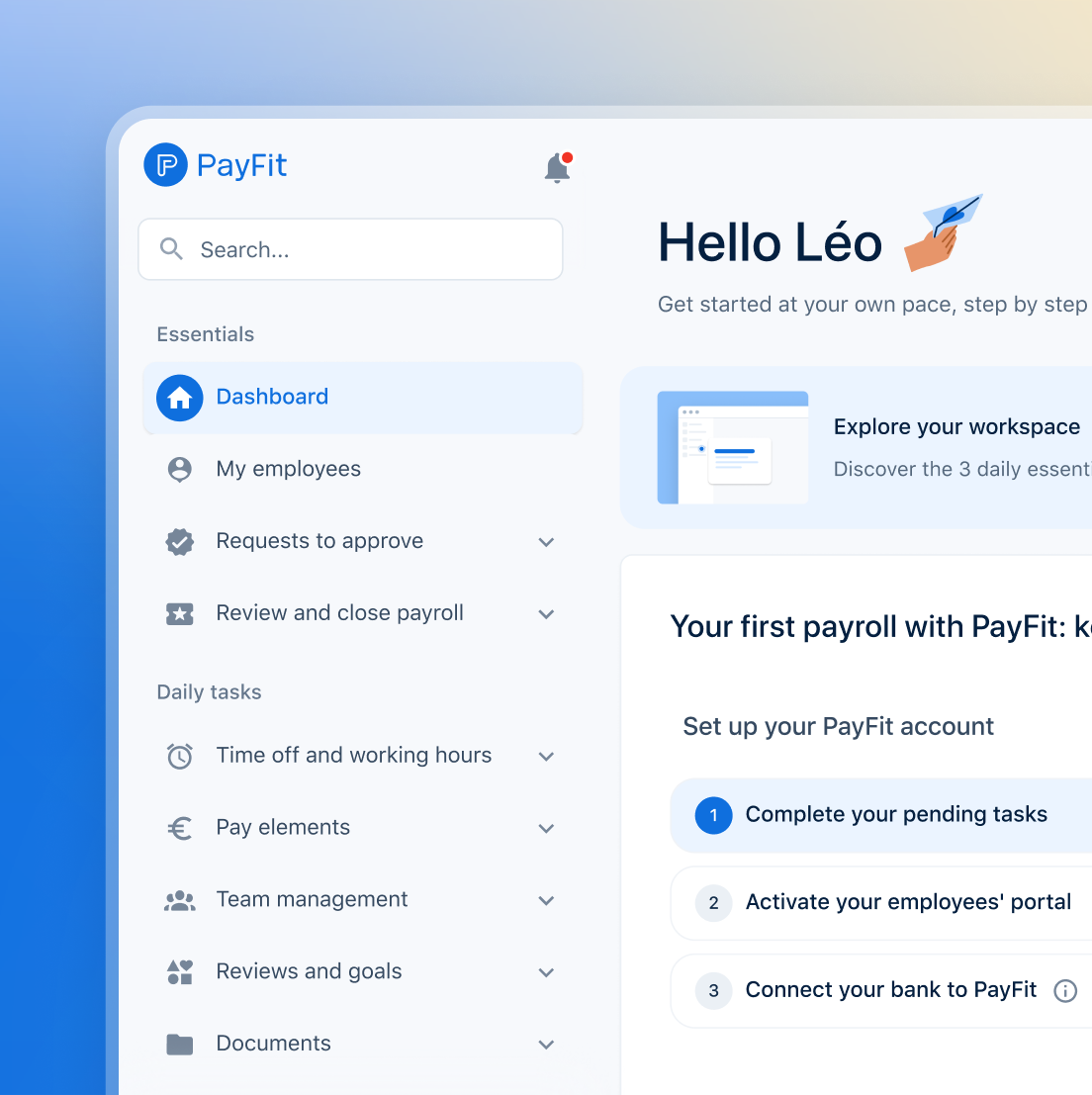
See what's new in PayFit
New features to save you time and give you back control. Watch now to see what's possible